
Most owners I talk to have a job, a service or a piece of equipment that works. It works when the right person does it, on a good day, with nobody rushing. What they often do not have is a repeatable process, and that gap is where time, money and customers quietly leak out.
You see it as the customer who got a great result in March and an average one in June. The quote that made money once and lost money the next time. The new hire who does the job fine, but differently every time. Nothing is broken, exactly. It just does not repeat.
The Punch Press That Worked
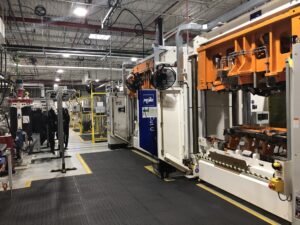
A few years ago I was the project engineer on a large automotive interior launch. A student and I wrote 14 equipment statements of work for it. A statement of work, or SOW, is the document that tells a supplier exactly what you are buying and what it has to do. The list ran from injection moulds and ultrasonic welders to two punch presses. A punch press, for anyone outside a plant, is the machine that punches holes and trims shapes into the moulded part. The punch die is the hardened tool inside the punch press that does the shearing work.
By August 2020, 90 percent of the equipment was on our floor. We were getting ready for production demonstration runs, which are full-rate runs to prove the line can make good parts at the volumes the customer needs. We were lining up people on the floor, checking that we had enough packaging on hand, and tweaking each machine until it made good product at rate.
The punch press supplier had sold us on a concept, and the concept worked. Load a part, cycle the press, and you got a punched part. But the press had been designed without alignment to a datum system. A datum is the fixed reference point that every measurement and every location is taken from. Without one, the part can sit a little differently in the die each time, and the cuts can land a little differently each time.
So it worked. It just did not repeat. For our situation there are trim lines on the skin that the punch should be removing. Our quality department noticed then showing up from time to time. Next we started seeing fit issues with the inspection jig. Was it skin to substrate misaglinment something off in the substrate? Why was one part OK and the next not OK. Upon closer inspection we found that there was no alignment system in the punch die. The standard datum system that was designed into the part was not being used by the punch die. The part was a general geometry location with w 50″ Long part with all kinds of thermal and process variation.
Working Once Is Not the Same as Working Every Time
Here is the trap. When something works, everybody relaxes. The supplier showed it working. We saw it working. On a demonstration you are looking for a good part, and good parts came out. A demonstration proves a concept. It does not prove a repeatable process.
I worked with our in-house tool and die team to build alignment into the three punch dies that ran in the two presses. We simply introduced a F/A pin and a C/C pin that matched the part geometry in design and was used in car. Once the part located the same way on every cycle, the presses gave us repeatable results. The last 10 percent of the equipment came in as late additions, needed because of part behaviour after punching that nobody had anticipated.
None of this was a knowledge problem. Our tool and die people knew how to locate a part. The equipment supplier knew what a datum was. It is rarely a knowledge problem, it is usually a time problem. With 14 pieces of equipment to specify, build and ship, nobody had made the time to write repeatability into what we were buying. Fixing it on the floor took far longer than writing it down would have. Luckily we had a magician of a tool maker in-house. He pulled the die insert that required the pin and added it using our rough in-house equipment. Problem solved.
Ask for Repeatability Before You Buy
A lesson like that only helps if it reaches the next purchase. After the launch, I gathered the team’s lessons, things gone right and things gone wrong, into a database we drew on every time we issued a new SOW. We used a templated SOW for each piece of equipment and I added part datum alignment to each template. This is front loading. When a second version of the product came along that needed a duplicate of every piece of equipment, it was the chance to front-load those lessons before anything was built. This is what leads to a vertical launch.
Front-load the decisions that are expensive to change later. Whether a machine locates a part the same way every time is one of those decisions. Asking for it in the SOW costs a sentence. Adding it after the press is on your floor costs tool and die time, extra trials and pressure on a launch schedule that is already tight. If you want a repeatable process, you have to ask for one in writing.
The other half is the acceptance test, the check you run before you agree the job is done. “Show me a good part” is not an acceptance test. “Show me 300 parts in a row, run by our own operator, all within tolerance” is. That is how you buy a repeatable process instead of a demonstration. That is where your tooling signoff for final payment lives.
What a Repeatable Process Means for Your Business
You may never buy a punch press. But you are sold things on a demonstration all the time, and you hand off work that only works when the right person does it.
A trades business has one crew lead who leaves every site clean and every customer happy. The other crew does good work, but the customer gets a different experience each time. One crew has a repeatable process. The other has talent.
A service business buys scheduling software after a slick demo. It works in the demo. Three months later, half the team books appointments one way and half another, and nobody trusts the calendar.
A shop owner quotes jobs from memory. Some quotes make money, some do not, and nobody can say why.
In each case the missing piece is the datum, the fixed reference point everyone starts from. In a business that might be a checklist, a standard quote sheet, a booking rule or a short note that says what done looks like. It is not fancy. It just means the job starts from the same place every time, no matter who does it.
This is also why I say every working automated system started as a working manual one. If a job does not repeat when people do it by hand, software will not make it repeat any better. It will only make the differences happen faster. Get a repeatable process working by hand first, then decide whether a tool would help.
One Thing to Do This Week
Pick one job in your business that works. A quote, an install, a new customer setup, the month-end billing. Then:
- Watch it done three times, by at least two different people if you can, and write down what changed each time.
- Find the step where the result starts to drift. That is where your missing datum is.
- Write one short reference for that step: a checklist, a template or a rule everyone starts from.
- Before you sign for your next piece of equipment, software or outside service, write down how you will know it repeats, not just that it works.
That last step is the one that saves the most money. A repeatable process is far cheaper to ask for before you buy than to build after it arrives.
Let’s Find Where Your Business Drifts
If part of your business works but is not yet a repeatable process, and you can feel it costing you time, money or customers, I would be glad to talk it through. I have spent 35 years in moulding and product development and hold a PMP, and finding the step where a process drifts is a big part of what I do. The first conversation is free, and it is about one thing: where your business is losing time, money or customers.
Book a free first conversation.Free Downloads Contact
Launchpad Project Management: I help entrepreneurs find the real problem first, then build and automate the fix.
Christopher Morewood PMP® 905-963-0800 workchristopher.morewood@launchpadprojectmanagement.com